Kidney stones are hard deposits made of minerals and salts that form inside the kidneys. Many people come to know about them only when a sudden, severe pain forces them to see a doctor. Knowing the early signs, and knowing where the pain is likely to be felt, can help you act sooner and avoid unnecessary delay.
The most common kidney stone symptoms are sudden, severe pain in the side or back below the ribs, which may move towards the lower abdomen or groin, along with blood in the urine, nausea or vomiting, and urinary changes such as burning or urgency. Not everyone has all of these. Symptoms depend on the size of the stone, where it is sitting, and whether it is blocking the flow of urine.
This guide explains the symptoms in plain language, shows where kidney stone pain usually occurs, compares kidney stones with a urinary tract infection (UTI), and lists the warning signs that need urgent medical care.
What Are Kidney Stones?
Kidney stones (also called renal calculi) are solid, crystal-like masses that form when certain substances in urine become too concentrated. Normally, urine carries these substances out of the body without trouble. When urine is very concentrated, or when it has too much of a stone-forming mineral, crystals can stick together and slowly grow into a stone.
Common types of kidney stones
- Calcium oxalate stones: the most common type.
- Calcium phosphate stones: less common, sometimes linked to certain metabolic conditions.
- Uric acid stones: more likely when urine is persistently acidic, and sometimes seen in people with high uric acid levels.
- Struvite stones: usually linked to repeated urinary infections.
- Cystine stones: rare, and caused by an inherited condition.
Why some stones cause symptoms and others do not
A stone sitting quietly inside the kidney may cause no pain at all. Problems usually begin when the stone moves into the ureter, the narrow tube that carries urine from the kidney to the bladder. The ureter is thin, so even a small stone can block urine for a while. The kidney then swells slightly because urine cannot drain, and the ureter goes into spasm as it tries to push the stone along. This stretching and spasm is what produces the typical sudden pain.
Common Kidney Stone Symptoms
The signs of kidney stones can look different from person to person. Here are the symptoms doctors most often see.
Severe Side or Flank Pain
The flank is the area on either side of the back, between the lower ribs and the hip. Pain from a kidney stone usually starts here, often on one side only.
People describe it as sharp, cramping, or stabbing. It often comes in waves, building up to a peak and then easing for a while before returning. This happens because the ureter contracts in spasms while trying to move the stone. The pain may become much more intense when the stone shifts position or lodges in a narrower part of the ureter.
Pain That Spreads to the Lower Abdomen or Groin
As a stone travels down the ureter towards the bladder, the pain often follows it. It may shift from the flank to the lower abdomen and then to the groin. In men, the discomfort can sometimes extend to the testicles. In women, it may be felt near the labia. This change in location is a useful clue, although it does not occur in everyone.
Blood in the Urine
Urine may look pink, red, or brownish if it contains blood. Blood can appear because a stone scrapes or irritates the delicate lining of the urinary tract. Sometimes the blood is too little to see and is found only on a urine test.
It is important not to assume that blood in the urine always means a kidney stone. UTIs, an enlarged prostate, kidney disease, certain medicines, and other conditions can also cause it. Any visible blood in the urine deserves a medical check.
Pain or Burning During Urination
When a stone reaches the lower end of the ureter, near the bladder, it can irritate the area and cause a burning or stinging feeling while passing urine. Because infection causes the same feeling, this symptom alone cannot tell the two apart.
Frequent or Urgent Urination
A stone near the bladder can create a repeated urge to urinate, even when only a small amount comes out. Some people feel they need to rush to the toilet more often than usual, including at night.
Nausea and Vomiting
The kidneys and the digestive system share nerve connections. Because of this, strong kidney pain often brings nausea, and some people vomit. This is common with kidney stone pain, but persistent vomiting needs medical attention (see the emergency section below).
Cloudy or Strong-Smelling Urine
Urine that looks cloudy or smells unusually strong can be a sign of infection, which sometimes accompanies a stone. It can also be caused by dehydration or by a simple UTI without any stone. So it is better treated as a prompt to get tested rather than a diagnosis by itself.
Several of these symptoms, including burning, urgency, and cloudy urine, can also occur with urinary tract infections and other conditions. That is why a proper medical evaluation matters.
Where Does Kidney Stone Pain Occur?
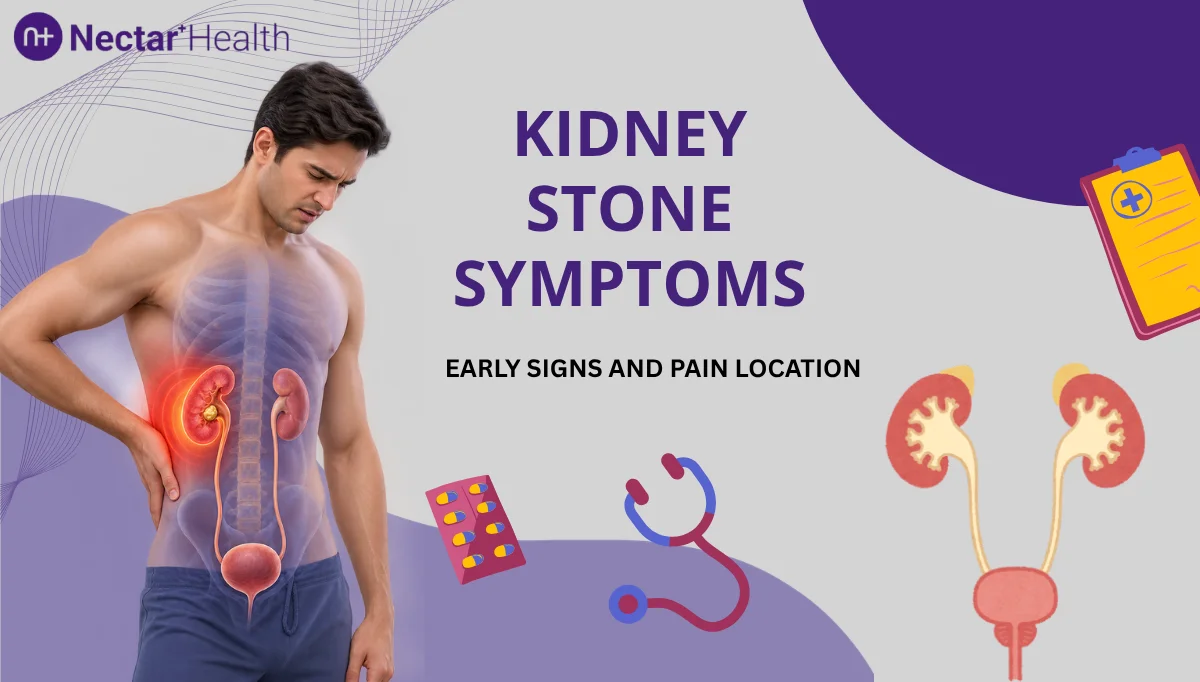
Kidney stone pain usually begins in the side or back, just below the ribs, and often moves towards the lower abdomen and groin as the stone travels down the ureter towards the bladder.
Here is how the pain location commonly relates to the stone's position:
- Side of the back (flank): typical when the stone is in the kidney or the upper ureter.
- Around the ribs or waist: the pain may be felt just under the rib cage and wrap around the side.
- Lower back: some people feel it as a deep ache in the lower back rather than at the side.
- Lower abdomen: as the stone moves down, pain may be felt in the lower part of the belly on the same side.
- Groin: a stone in the lower ureter often causes pain in the groin, and may spread to the thigh, testicles, or genital area.
The pain typically stays on one side. Pain on both sides at once is less typical and is worth discussing with a doctor. Also, the pain may not travel in a neat line for everyone. Some people feel it in only one spot throughout.
What Are the Early Symptoms of Kidney Stones?
Early signs of kidney stones can include mild or on-and-off discomfort in the side or back, blood in the urine, a frequent urge to urinate, burning while passing urine, and pain that gradually builds up as the stone moves.
In the early stage, you may notice:
- A dull or intermittent ache in the flank that comes and goes.
- Changes in urination, such as passing small amounts more often.
- Pink, red, or brown urine.
- A sudden urge to urinate.
- A burning sensation during urination.
- Pain that slowly becomes sharper or more frequent.
It is also worth knowing that some kidney stones cause no symptoms at all. They may be discovered by chance during a scan done for another reason. Symptoms typically begin only when the stone moves or blocks the flow of urine.
What Does Kidney Stone Pain Feel Like?
Kidney stone pain is often described as one of the more intense kinds of pain, but severity varies widely. Some people have mild discomfort, while others have severe pain that needs emergency treatment.
Common features include:
- Sudden onset: the pain may start without warning, sometimes at night or early morning.
- Sharp or severe quality: many people describe a stabbing or cramping pain.
- Waves of pain: it rises and falls over minutes, rather than staying constant.
- Changing location: it may move from the back to the abdomen and groin.
- Restlessness: unlike many other types of pain, where lying still helps, people with kidney stone pain often cannot find a comfortable position and keep shifting or pacing.
- Nausea or vomiting: these often accompany the pain.
If your pain does not fit this pattern, that does not rule out a stone, and equally, this pattern does not confirm one. Many other conditions, including appendicitis, muscle strain, and gallbladder or gynaecological problems, can cause pain in the same areas.
Kidney Stone Symptoms in Men and Women
The core symptoms of kidney stones are generally similar in men and women: flank pain, pain that moves to the lower abdomen or groin, blood in the urine, nausea, and urinary changes.
There can be differences in how the pain spreads. Men may feel pain extending to the testicles or tip of the penis, while women may feel it in the lower abdomen or pelvic area. Because women's pelvic pain can also come from conditions such as ovarian cysts, endometriosis, or UTIs, kidney stones are sometimes mistaken for other problems. In men, prostate-related conditions can occasionally cause similar urinary symptoms.
In short, the symptoms are largely alike, but the other conditions that need to be ruled out can differ. A doctor can sort this out with an examination and tests.
Kidney Stone Symptoms vs UTI Symptoms
Kidney stones and UTIs can feel alike, and they can also occur together. A stone can block urine and make infection more likely. Here is a simple comparison:
| Symptom | Kidney Stones | UTI |
|---|---|---|
| Flank pain | Common, especially with obstruction | Possible, especially with kidney infection |
| Burning urination | Possible | Common |
| Blood in urine | Possible | Possible |
| Frequent urination | Possible | Common |
| Severe waves of pain | More characteristic | Less typical |
| Fever/chills | Concerning for infection | Can occur, especially with kidney infection |
Because symptoms overlap so much, you cannot reliably tell the two apart at home. Only a healthcare professional, usually with a urine test and sometimes imaging, can determine the cause. Fever with flank pain, in particular, should never be ignored.
When Are Kidney Stone Symptoms an Emergency?
Most kidney stones can be managed without serious complications, but some situations need quick medical care. A blocked urinary tract combined with infection can become serious, because infected urine that cannot drain may spread into the kidney or bloodstream.
Seek urgent medical care if you have:
- Fever or chills along with side or back pain, or other symptoms of a suspected kidney stone.
- Severe pain that is getting worse or is not easing.
- Vomiting that continues, or an inability to keep fluids down.
- Difficulty passing urine, or no urine at all.
- Signs of infection, such as fever, shivering, a fast heartbeat, or confusion.
- Significant blood in the urine, or blood clots.
- Severe weakness, dizziness, or feeling very unwell.
Please also seek early assessment if you have only one working kidney, existing kidney disease, a kidney transplant, diabetes, a weakened immune system, or are pregnant, because complications can develop faster or be harder to manage. The same applies to young children and older adults.
If you are unsure, it is safer to get checked. Going to a hospital for a symptom that turns out to be minor is far better than waiting on a serious one.
What Causes Kidney Stones?
There is rarely a single cause. Several factors can increase the chance of stone formation:
- Not drinking enough fluids: low fluid intake makes urine concentrated, which makes crystal formation easier. Hot weather and heavy sweating add to this.
- High levels of certain minerals in urine: such as calcium, oxalate, or uric acid.
- High salt intake: this can increase calcium in the urine.
- Certain dietary patterns: for example, a diet very high in animal protein or in sugary drinks.
- Family history: stones tend to run in some families.
- Previous kidney stones: a person who has had one stone has a higher chance of another.
- Some medical conditions: such as gout, hyperparathyroidism, recurrent UTIs, inflammatory bowel conditions, obesity, and some inherited disorders.
- Certain medications and supplements: some medicines and high-dose supplements can affect stone risk, so do not stop any prescribed medicine on your own.
Having a risk factor does not mean you will definitely get a stone, and many people with stones have no obvious risk factor.
How Are Kidney Stones Diagnosed?
A doctor decides which tests are needed based on your symptoms and overall health. Common steps include:
- Medical history: your symptoms, past stones, family history, diet, and medicines.
- Physical examination: to check for tenderness and signs of infection or dehydration.
- Urine tests: to look for blood, infection, and crystals.
- Blood tests: to check kidney function and levels of calcium, uric acid, and other substances.
- Ultrasound: a safe, radiation-free test that can show stones and swelling of the kidney. It is often used first, and especially in pregnancy and children.
- CT scan: a low-dose non-contrast CT is often the most accurate way to find a stone's size and position, and is used when appropriate.
- Other imaging: such as an X-ray of the abdomen, or other scans in selected cases.
If you pass a stone, your doctor may ask you to collect it so that it can be analysed. Knowing the stone type helps in planning prevention.
How Are Kidney Stones Treated?
Treatment depends on the stone's size, location, symptoms, and whether there is infection or blockage. The overview below is general, and your doctor will recommend what suits you.
- Waiting for the stone to pass: many small stones pass on their own, usually with monitoring and follow-up.
- Pain management: pain relief should be taken only under medical guidance, as some pain medicines are unsafe for people with kidney problems or other conditions.
- Hydration: your doctor will advise how much fluid is appropriate for you, since the right amount differs from person to person.
- Medicines: in selected cases, doctors may prescribe medicines that help relax the ureter or help control nausea or infection.
- Procedures for larger or blocking stones:
- Shock wave lithotripsy (SWL): sound waves from outside the body break the stone into smaller pieces that can pass in urine.
- Ureteroscopy: a thin scope is passed through the urinary tract to reach the stone, which is then broken up or removed.
- Surgical treatment in selected cases: such as percutaneous nephrolithotomy (PCNL) for large kidney stones, done through a small cut in the back.
- Treatment of complications: if a stone is blocking urine along with infection, doctors may need to drain the kidney urgently, for example by placing a stent or a drainage tube, before treating the stone itself.
Please do not self-medicate or try home remedies in place of medical evaluation, especially if pain is severe or there is fever.
How Can Kidney Stones Be Prevented?
Prevention depends partly on the type of stone, but some measures help most people.
- Drink enough fluids: doctors often aim for a urine output of about 2 to 2.5 litres a day, which usually means drinking more in hot weather or when you sweat a lot. Water is the best choice. If you have heart, kidney, or liver disease, ask your doctor before increasing fluids.
- Reduce excess salt: go easy on packaged snacks, pickles, papad, and processed foods.
- Follow a balanced diet: include fruits, vegetables, and whole grains. Do not cut out calcium-rich foods on your own, as very low calcium intake can actually raise stone risk for some people.
- Moderate animal protein and sugary drinks: excess amounts may raise risk.
- Maintain a healthy weight: obesity is linked to a higher chance of stones.
- Know your stone type: a stone analysis and urine tests can guide specific advice, such as limiting high-oxalate foods if you form oxalate stones.
- Follow medical advice for recurrent stones: people who keep forming stones may need a detailed metabolic evaluation and sometimes preventive medicines.
No single food or drink can guarantee that you will never get a kidney stone. Steady, long-term habits matter more than any one remedy.