What Is Peyronie's Disease?
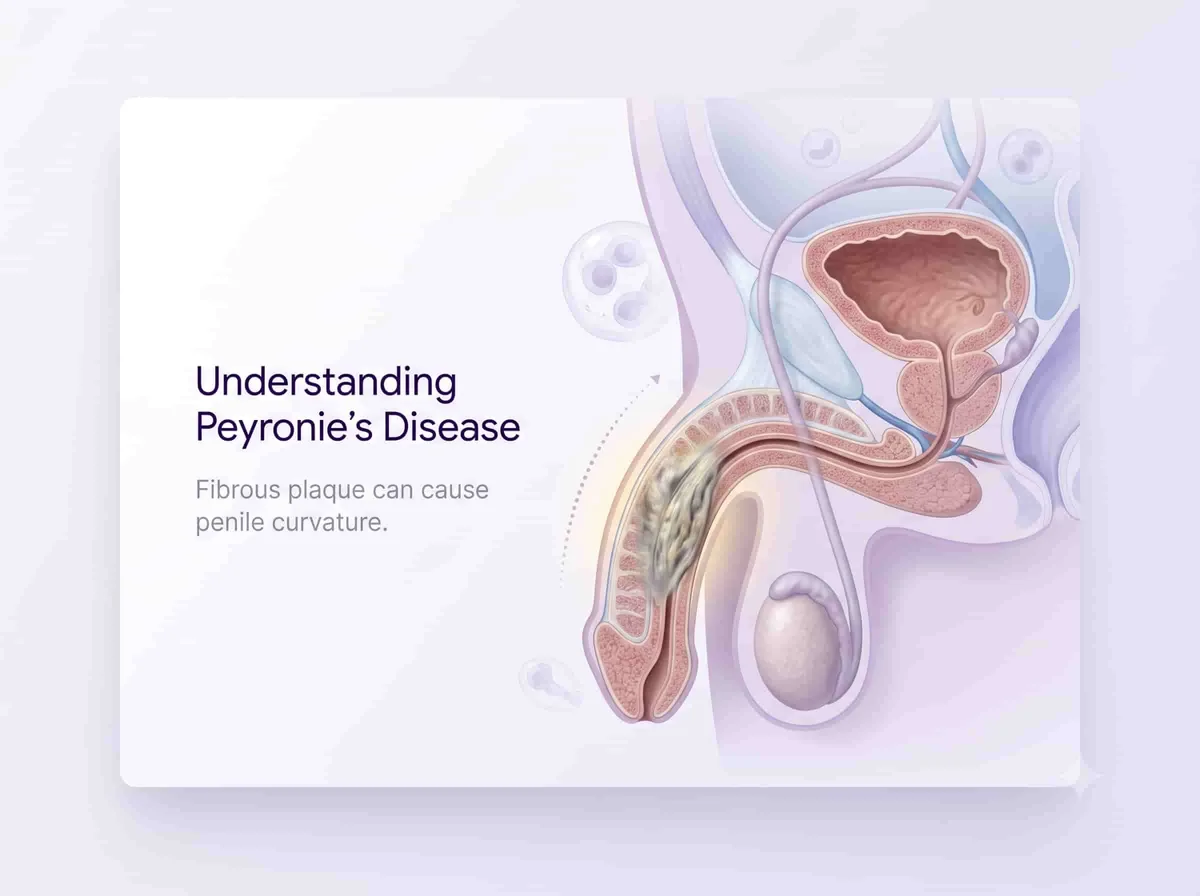
Peyronie's disease (pronounced pay-ro-NEEZ) is a condition in which a patch of fibrous scar tissue, called a plaque, forms under the skin of the penis. Mayo Clinic describes it as causing curved, sometimes painful erections, and in some men a shorter erect penis. The word "plaque" here has nothing to do with the plaque on teeth or in arteries. It simply means a firm area of scar tissue.
The penis has a stretchy sheath of tissue around the erection chambers. When a scar plaque forms in that sheath, that area cannot stretch as much as the rest during an erection. The penis then bends towards the side where the plaque sits. A plaque on top usually pulls the penis upwards, one underneath pulls it downwards, and a plaque on the side bends it sideways.
Two points that often ease readers' minds: Peyronie's disease is not cancer, and it is not a sexually transmitted infection.
Is a Curved Penis Normal or a Sign of Peyronie's Disease?
A slight curve can be completely normal. The NHS notes that a slight natural curve is common, and Mayo Clinic says mild curvature in younger men is usually normal and is a separate condition called congenital (present from birth) penile curvature.
Here are some practical differences to look out for:
| Natural curve | Peyronie's disease | |
|---|---|---|
| When it started | Present since puberty, unchanged over time | Develops or changes later, often in adulthood |
| Lump or hard area | Usually none | A firm lump or band can often be felt under the skin |
| Pain | Usually none | May have pain, especially with erections, in the early phase |
| Shape change | Stable | May worsen, with shortening or a narrowed, "hourglass" look |
| Effect on sex | Usually none | May make penetration painful or difficult, or affect erections |
This table is only a guide. You cannot reliably diagnose yourself, and a doctor's examination is the way to tell for sure. A mild curve that has been there all along and causes no pain or problems does not need treatment.
Common Symptoms of Peyronie's Disease
Symptoms can appear gradually or fairly suddenly. According to the NHS and Mayo Clinic, they may include:
- A hard lump or band that you can feel on the shaft, sometimes tender to touch.
- A curved penis during erection, bending upwards, downwards or to one side.
- Painful erections. The pain often settles within a year or two, even when the curve does not.
- Shortening of the erect penis.
- Narrowing or an "hourglass" or indented shape in part of the shaft.
- Erection difficulty, such as trouble getting or keeping an erection. Mayo Clinic notes that many men notice this before other symptoms appear.
Also, curvature is often easier to notice during an erection than when the penis is relaxed, so it is the erect shape that matters most.
The condition tends to move through two phases. In the early (active) phase, which Mayo Clinic says usually covers the first year to year and a half, the plaque is forming and the curve may worsen or stay the same. Pain is more common in this phase. In the later (stable) phase, the pain usually fades and the curvature stops changing, though it generally does not disappear. The AUA and EAU both describe stable disease as unchanged for around three months or more, with pain settled. Doctors pay close attention to which phase you are in, since it influences treatment choices.
What Causes Peyronie's Disease?
The exact cause is not fully known. The most widely accepted explanation, described by Mayo Clinic, is that repeated minor injury to the penis, for example during vigorous sex, a sports injury or an accident, leads to abnormal scarring while the tissue heals. The plaque then forms in the sheath around the erection chambers.
But many men with Peyronie's disease cannot recall any injury at all, so injury is not the full story. Researchers are still studying possible genetic and health-related links. In short, it is not caused by something you did wrong, and it is not caused by cancer or infection.
Risk Factors Associated With Peyronie's Disease
Mayo Clinic and the NHS list the following as being linked with a higher chance of developing it:
- Age. It becomes more common in middle age, with Mayo Clinic citing roughly 45 to 70 years. It can still occur in younger men.
- Family history of Peyronie's disease.
- Connective tissue conditions, such as Dupuytren's contracture, a thickening of tissue in the palm that makes fingers curl.
- Some health conditions and medicines. The NHS lists diabetes, high blood pressure, high cholesterol, coronary heart disease and arteriosclerosis (hardening of the arteries), and certain medicines such as beta blockers and antidepressants, as associated. These are links, not proof that one causes the other. Never stop a prescribed medicine on your own because of this. Talk to your doctor first.
- Prostate surgery and smoking. Mayo Clinic lists some types of prostate surgery and smoking as associated factors.
Having a risk factor does not mean you will develop the condition, and many men with Peyronie's disease have none of these.
How Is Peyronie's Disease Diagnosed?
Peyronie's disease diagnosis is mostly a matter of listening and examining. The AUA guideline says it rests on your history and a genital examination.
Your doctor will usually ask:
- When you first noticed the curve, and whether it is changing.
- Whether you have pain, and when.
- How the curve affects intercourse and your erections.
- How much it bothers you, and your partner.
- About your health conditions, medicines and any past injury or surgery.
The examination checks for a plaque and may record your stretched or erect penile length as a baseline. Photos of your erect penis taken at home are very useful, since the curve may not show in the clinic. An ultrasound may be advised. Before an invasive treatment or surgery, a specialist may assess the erect shape and blood flow in the clinic, which can involve a medicine injection to produce an erection. Both the AUA and EAU describe this step.
Diagnosis does not usually require an MRI or a biopsy.
Peyronie's Disease Treatment Options
The right treatment depends on the stage (active or stable), how severe the curve is, whether you have pain, whether erections are firm enough for sex, and what matters to you. Many men do not need treatment. Others do best with a combination. A urologist with experience in Peyronie's disease is the best person to guide this.
Watchful waiting
If the curve is mild, painless and does not interfere with sex, monitoring may be all you need. The NHS says mild cases may need no treatment. Your doctor will check that things are not progressing.
Medicines taken by mouth
Pain relievers called NSAIDs (such as ibuprofen) may be used for pain in the active phase, according to the AUA and EAU. If erectile dysfunction is also present, medicines for erections may be suggested. The AUA and EAU specifically advise against several oral products promoted for Peyronie's disease, including vitamin E, tamoxifen and L-carnitine, because evidence of benefit is lacking. So please do not buy supplements or "curve-correcting" pills on your own. They may waste money and delay proper care.
Injections into the plaque
For stable disease, a urologist may offer injections into the plaque.
- Collagenase clostridium histolyticum has the strongest evidence of the injectable options, according to the EAU, though it also notes high placebo effects. It is used together with manual "modelling" of the penis. Bruising, pain and swelling are common, and rare serious problems, including rupture of the erection tissue, can occur. Availability varies by country. The EAU notes it has been withdrawn from the European market, so ask your doctor whether it is available to you in India.
- Interferon alfa-2b and verapamil have more limited evidence and may be considered in selected cases.
These treatments are for specific situations, such as stable disease with a moderate curve and working erections, and are not suitable for everyone.
Traction and vacuum devices
Some men use a penile traction device that gently stretches the penis for set periods each day over many months. The EAU says traction and vacuum devices may help, but the outcome data are limited. The NHS adds that devices need daily use for months. Choose a device only on your urologist's advice, and stop and seek advice if you have pain, numbness or skin damage.
Shockwave therapy and other options
The NHS lists shockwave therapy among options. The EAU and AUA say it may relieve pain but does not improve the curve or reduce plaque size, so do not expect it to straighten the penis. Radiotherapy is not recommended by the AUA.
Surgery
Surgery is generally considered for stable disease, usually after the curve has been stable for some time, when the deformity is significant enough to prevent or seriously hinder sex. The EAU describes the main options:
- Shortening the longer side (such as plication): often the first choice if length is adequate and the curve is not complex. The most common drawback is some loss of length.
- Plaque cut and graft (lengthening procedures): for shorter penises or severe or complex curves, where erections are normal. These carry a higher risk of erection problems.
- Penile implant: for men who also have erectile dysfunction that medicines no longer control.
Surgery aims for a penis that is functionally straight enough for comfortable sex, not necessarily perfectly straight. Risks include shortening, changes in sensation, erection problems and recurrence. The NHS notes that surgery usually cannot return the penis to its shape before the curve developed.
What to do, and what not to do
- Do see a urologist early, since Mayo Clinic says early treatment offers the best chance of improvement.
- Do take dated photos of your erect penis, and note when pain started.
- Do talk openly with your partner, and consider counselling if you feel low or anxious.
- Do ask about the evidence, risks and expected outcomes for every option.
- Don't try to bend, straighten or "break" the penis yourself, which can cause injury.
- Don't use unverified oils, creams, pills or supplements, or buy medicines without a prescription.
- Don't ignore sudden severe pain, bruising or swelling after an injury. Seek urgent medical care.
Can Peyronie's Disease Affect Erections and Sexual Health?
It can, though not always. Some men have a visible curve and carry on with a normal sex life. In others, the curve, pain or shortening makes intercourse uncomfortable or hard to manage.
Peyronie's disease and erectile dysfunction are closely linked. Mayo Clinic lists difficulty getting or keeping an erection among the symptoms, and notes that it may appear before others. Pain, worry and a changed shape can all play a part. Sometimes the plaque itself affects blood flow in the penis.
The emotional side matters just as much. Mayo Clinic lists anxiety, stress, depression and relationship strain among the possible complications. Men may feel embarrassed, avoid intimacy or stop talking to a partner. If conceiving is a goal, difficulty with intercourse can also make that harder, even though the condition does not directly affect sperm.
The AUA guideline recommends that doctors check for distress in both you and your partner, and consider referral to a mental health professional with expertise in sexual health when needed. Some men choose counselling alone, and that is a perfectly valid choice. Talking helps more than silence.
When Should You See a Doctor for a Curved Penis?
See a urologist, or start with your family doctor, if you notice any of the following:
- A new curve, or a curve that is getting worse.
- A lump or hard band under the skin.
- Pain with erections.
- A shorter or narrower erect penis.
- Difficulty getting or keeping erections, or difficulty with sex because of the curve.
- Distress, low mood or avoiding intimacy because of how your penis looks or works.
The earlier you go, the more options you may have. Mayo Clinic says early treatment gives the best chance of improving the condition or stopping it from worsening.
If the curve has been there since your teens, causes no pain and has never troubled you or your partner, you may not need treatment, although you can still ask a doctor for reassurance.
Seek urgent care if you hear a snap or pop during sex followed by sudden severe pain, rapid swelling or bruising, or if you cannot pass urine. These can be signs of a penile injury that needs emergency treatment.
Can Peyronie's Disease Go Away on Its Own?
Sometimes the pain fades without treatment, but the curve itself rarely goes away. Mayo Clinic says spontaneous improvement of curvature and pain is uncommon. In the early phase the curve may stay the same or get worse. Pain usually settles within one to two years, while the scar tissue, curve and shortening often stay.
That does not mean nothing can be done. Treatment may ease pain, reduce the bend or help you have comfortable sex, even after the condition has been present for a while. Nobody can promise a complete cure, and results vary from man to man. A urologist can give you a realistic outlook for your own case.
Conclusion
A curved penis is often completely normal. Peyronie's disease is a real but treatable medical condition that is worth recognising early. If your curve is new, changing, painful, comes with a lump, or affects your erections or your confidence, please see a urologist. There is nothing to be embarrassed about. Doctors see this regularly, and the sooner you ask, the more choices you tend to have.
Medical disclaimer: This article is for educational purposes only and does not replace professional medical advice, diagnosis or treatment. Please consult a qualified urologist or doctor about your symptoms. Your health matters more than any article.