Few health problems are as common and as rarely discussed as piles. Many people in India put up with bleeding, itching or a painful lump for months. Some feel embarrassed to see a doctor. Others try a neighbour’s remedy or a cream from the chemist and hope for the best.
This guide explains what piles are, how the four grades differ, which treatments are available (many of them without surgery) and when you should stop waiting and get checked.
What Are Piles (Haemorrhoids)?
Piles are known medically as haemorrhoids. They are swollen, enlarged blood vessels in or around the anus and lower rectum. Haemorrhoids, also known as piles, are swellings containing enlarged blood vessels found inside or around the bottom. nidirect
Everyone has soft vascular cushions in the anal canal. They help with stool control. Problems start when these cushions swell, stretch or slip downwards, usually because of repeated pressure from straining, constipation or other factors.
Internal vs External Haemorrhoids
Doctors classify haemorrhoids by where they form. They are classed as external or internal, depending on their position relative to the dentate line, a natural landmark inside the anal canal. scot
- Internal haemorrhoids form inside the rectum, above the dentate line. This area has few pain-sensing nerves, so internal piles are often painless. Bleeding is usually the first sign.
- External haemorrhoids form under the skin around the anus. This skin is very sensitive, so they can be itchy, tender or painful.
Some people have both types at the same time.
Common Symptoms of Piles
Piles symptoms vary from person to person. In many cases, haemorrhoids don’t cause symptoms, and some people don’t even realise they have them. When symptoms do appear, they may include: nidirect
- Rectal bleeding: bright red blood on the toilet paper, in the toilet bowl, or dripping after a bowel movement. These are the classic bleeding piles.
- Itching or irritation around the anus.
- Pain or discomfort, especially while sitting or passing stool.
- Swelling or a lump near the anus.
- Mucus discharge or a feeling that the bowel hasn’t emptied fully.
- Soreness or dampness around the anus, which can make hygiene difficult.
Don’t Assume Every Bleed Is Piles
This point matters. Bleeding from the back passage is common with piles, but it is not always piles. Anal fissures (small tears), infections, inflammatory bowel disease, polyps and colorectal cancer can all cause similar symptoms. NHS guidance says you should always get any rectal bleeding checked out, just in case there is something more serious causing it. nidirect
Never label rectal bleeding as “just piles” without a medical examination, especially if you are over 40 or the bleeding keeps coming back.
Different Grades of Piles
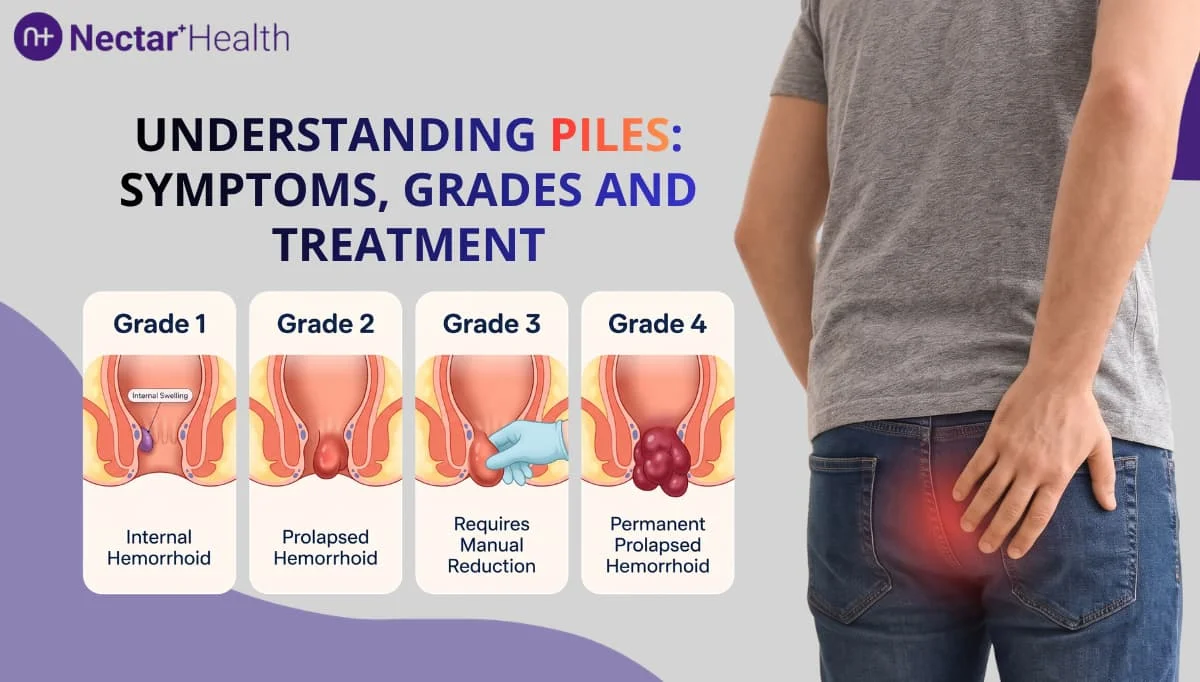
The grading system describes how far internal haemorrhoids slip down (prolapse) through the anal opening. It does not apply to external piles, which are simply described by their size and whether they are painful. Doctors use the grade to choose the most suitable treatment.
Grade 1 Piles
The haemorrhoids are swollen but stay inside the anal canal and do not prolapse. Painless bleeding after passing stool is the typical sign. You usually can’t see or feel the piles.
Grade 2 Piles
The haemorrhoids slip out during a bowel movement but go back in on their own afterwards. You may notice a soft lump that disappears by itself, along with bleeding or mild discomfort.
Grade 3 Piles
The haemorrhoids prolapse during passing stool (or even when walking or standing) and have to be pushed back in manually with a finger. Mucus leakage, soiling and irritation become more common.
Grade 4 Piles
The haemorrhoids stay permanently outside and cannot be pushed back. They can be painful and may become inflamed or develop clots. This grade usually needs specialist care.
A higher grade is not always more painful, and a lower grade is not always harmless. The grade is a guide, and your doctor will also weigh your symptoms and examination findings.
Common Causes and Risk Factors
Piles develop when the veins around the anus are put under repeated pressure. Common causes of piles include:
- Chronic constipation and hard stools
- Straining during bowel movements
- Sitting on the toilet for long periods, including scrolling on the phone
- Low-fibre diets, such as heavy reliance on refined flour (maida), fast food, and too few vegetables, fruit and dal
- Chronic diarrhoea, which irritates the area
- Pregnancy, because of the baby’s weight and hormonal effects on the veins
- Obesity
- Ageing, as supporting tissues weaken over time
- Heavy lifting and long hours of sitting or standing
- Family history, as some people are more prone to piles than others
Many of these are linked to daily habits, which means a good number of them can be changed.
Internal vs External Piles: A Quick Comparison
| Feature | Internal piles | External piles |
|---|---|---|
| Location | Inside the rectum | Under the skin around the anus |
| Pain | Usually painless | Often painful or tender |
| Main symptom | Bleeding, prolapse | Itching, swelling, lump |
| Graded? | Yes (Grades 1–4) | No |
| Possible complication | Prolapse, ongoing blood loss | Blood clot (thrombosed pile), skin tags |
A thrombosed external pile (one with a blood clot inside) causes sudden, severe pain and a hard, tender lump. If you suspect this, see a doctor promptly.
How Are Piles Diagnosed?
Diagnosis usually starts with a conversation and a simple examination. A doctor can often diagnose haemorrhoids with a simple internal examination of the back passage. nidirect
- Medical history: Your doctor asks about bleeding, pain, bowel habits, diet, medicines and family history.
- Physical examination: The area around the anus is checked for lumps, skin tags and signs of irritation.
- Digital rectal examination (DRE): The doctor gently feels inside the lower rectum with a gloved, lubricated finger to check for lumps and tenderness.
- Anoscopy (proctoscopy): A short, lit tube lets the doctor see the inside of the anal canal and confirm internal haemorrhoids.
When Is a Colonoscopy Needed?
If piles are not the only possible explanation for your bleeding, your doctor may advise a colonoscopy or flexible sigmoidoscopy to look further up the bowel. This is more likely if:
- You are middle-aged or older and have new rectal bleeding
- There has been a recent change in bowel habits
- You have unexplained weight loss or anaemia
- There is a family history of colorectal cancer or polyps
- Bleeding persists despite treatment
This is a way of making sure nothing more serious is being missed.
Treatment Options for Piles
Treatment depends on your symptoms, the grade, examination findings and your overall health. Not every case of piles needs surgery. NHS guidance notes that if home treatments don’t help, you may need hospital treatment, and the best option should be discussed with your doctor. nhs.uk
1. Lifestyle and Dietary Changes (Mild Symptoms)
For early-stage piles, this is where treatment begins. Eating more fibre, drinking enough water, staying active and not straining often ease symptoms. NHS and Irish health service guidance both recommend simple dietary changes and avoiding straining on the toilet as first-line steps. nidirect
2. Fibre Supplements and Short-Term Symptom Relief
- Fibre supplements (such as psyllium/isabgol husk) can soften stools. Introduce them gradually and with plenty of water.
- Stool softeners may be suggested by your doctor if constipation is a problem.
- Creams, ointments and suppositories may ease itching, pain and swelling. Hospital guidance notes that these do not “cure” haemorrhoids but may ease symptoms such as discomfort and itch. uhliverpool
A word of caution: Please don’t self-medicate for long. Creams containing steroids should only be used for a short period and under medical advice, because prolonged use can thin and damage the skin. Avoid unverified herbal or “guaranteed cure” products, including those advertised on social media. If symptoms persist beyond about a week of home care, see a doctor.
3. Non-Surgical (Office-Based) Procedures
If lifestyle measures aren’t enough, doctors often offer simple outpatient procedures. This is the most common answer to “piles treatment without surgery”:
- Rubber band ligation: A tiny elastic band is placed at the base of an internal pile, cutting off its blood supply so it shrinks and falls off. It is commonly used for Grade 2 and 3 piles, and sometimes Grade 1. It is usually done in an outpatient clinic. uhliverpool
- Sclerotherapy: A chemical solution is injected near the haemorrhoid to shrink it. It is generally used for smaller, lower-grade piles.
- Infrared coagulation: A short burst of infrared heat seals the blood vessels feeding the pile. It is mainly used for smaller internal piles.
These are not always one-time fixes, and the piles can return, especially if constipation or straining continues.
4. Surgical Options
Surgery is considered mainly for larger or higher-grade piles (Grade 3–4), for piles that haven’t responded to other treatments, or for complicated cases.
- Haemorrhoidectomy: The haemorrhoidal tissue is surgically removed. It is considered the most effective option for severe or recurrent piles, though recovery involves more pain and downtime.
- Stapled haemorrhoidopexy: A stapling device lifts the prolapsing tissue back into place and reduces its blood supply. It is used for selected prolapsing internal piles. Your surgeon will explain risks and the chance of recurrence.
Other techniques exist as well, and the right choice depends on your surgeon’s assessment.
Home Care and Relief Tips
Home care can ease symptoms and prevent flare-ups, but it cannot permanently remove all piles, and it isn’t a substitute for assessment if bleeding is present.
- Warm sitz baths: Sit in a few inches of warm (not hot) water for 10–15 minutes, once or twice daily and after bowel movements. This soothes pain and itching.
- Drink enough water through the day to keep stools soft.
- Eat fibre-rich foods regularly.
- Don’t strain, and don’t sit on the toilet for long. Leave the phone outside.
- Go when you feel the urge. Holding it in makes stools harder.
- Keep the area clean and dry. Gently pat with soft, unscented wipes or water instead of rubbing.
- Stay active. A daily walk helps bowel movement.
- Maintain a healthy weight.
Be realistic about limits. These steps often reduce symptoms, but they may not shrink large or prolapsed piles.
Foods to Eat and Avoid for Piles
Diet is one of the most practical tools you have. Aim for soft, bulky stools that pass easily.
Foods to Eat for Piles (Indian Options)
- Fruits: papaya, guava (with seeds), pear, apple with skin, banana, orange, and soaked prunes or figs (anjeer)
- Vegetables: lauki (bottle gourd), tori, palak, carrots, beetroot, peas, cabbage and cauliflower
- Whole grains: whole wheat roti (don’t over-sieve the atta), jowar, bajra, ragi, oats and brown rice
- Dals and legumes: moong, masoor, toor, rajma, chana and chhole
- Seeds and others: flaxseed (alsi), isabgol, nuts in moderation, and curd or buttermilk (chaas)
- Fluids: water, nimbu pani, coconut water, thin dal soup and buttermilk
Foods to Avoid or Limit in Piles
- Highly refined foods: maida, white bread, bakery items, noodles
- Fried and oily foods: samosas, pakoras, chips and street snacks
- Very spicy food, which can irritate some people’s piles and worsen discomfort
- Red meat and processed meats in large amounts
- Excess tea, coffee, and alcohol, which can contribute to dehydration
- Heavy cheese and other low-fibre dairy-heavy meals, if they make you constipated
Increase Fibre Gradually
Adding a lot of fibre overnight can cause bloating, gas and cramps. Add a little more each week, and drink more water as you do. Common guidance suggests roughly 25–30 g of fibre a day for adults, though individual needs differ [insert source: NHS/NIDDK].
Can Piles Go Away on Their Own?
Sometimes, yes. Mild piles often settle in a few days to a couple of weeks with better diet, softer stools and good bowel habits. NHS guidance notes that piles often get better on their own after a few days. wales
But “going away” does not mean “gone for good.” Piles can come back if the underlying habits don’t change. Medical treatment is needed when:
- Symptoms don’t improve after about a week of home care
- Bleeding continues or keeps returning
- Piles are prolapsing and don’t go back in
- Pain or discomfort affects your daily life
When Should You See a Doctor?
Please consult a doctor for piles if you notice any of these:
- Bleeding that is recurrent, persistent or heavy
- Severe pain or a hard, painful lump near the anus
- Dizziness, weakness, pale skin or fainting, which can signal significant blood loss
- Unexplained weight loss
- A change in bowel habits lasting more than a few weeks
- Blood mixed with stool, or black or tarry stools
- Piles that are getting worse, or that keep returning
- Fever, chills or pus from the area
Seek urgent medical help for heavy bleeding, fainting or severe pain. Hospital guidance advises urgent help if you have a very high temperature or feel hot, shivery and unwell, or have pus leaking from your piles. nhs.uk
Early assessment can rule out serious causes, and most piles can be treated without major surgery.