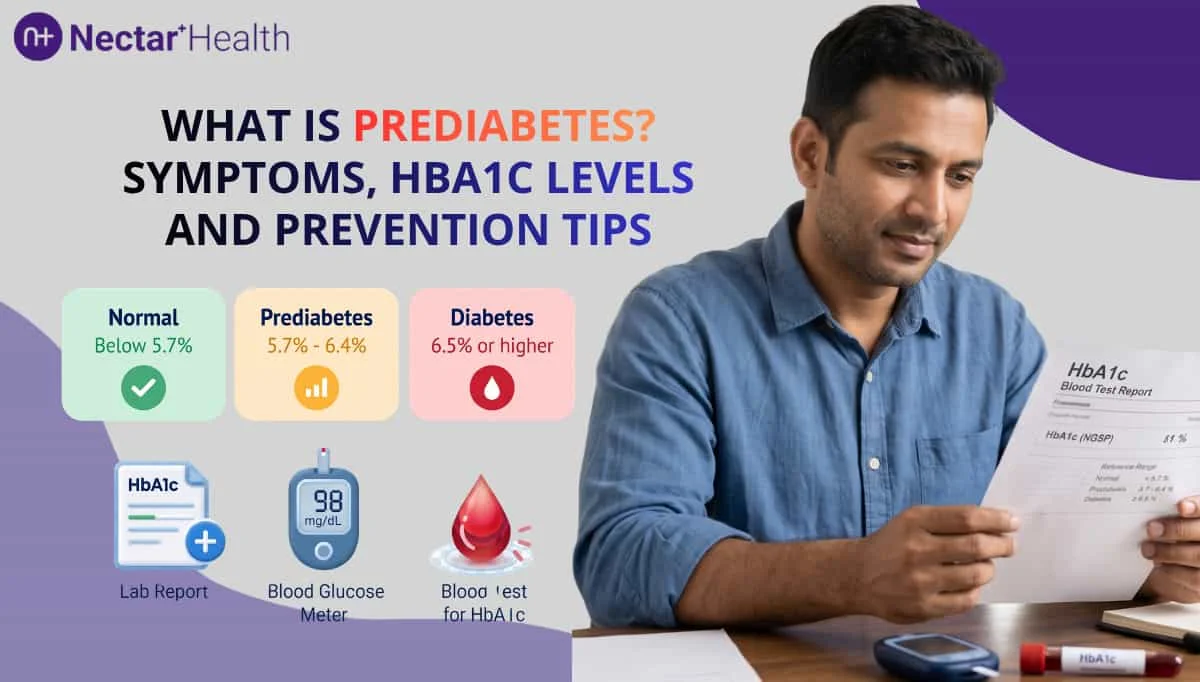
What Is Prediabetes?
Prediabetes means your blood sugar is higher than normal, but not high enough to be called type 2 diabetes. Think of it as a yellow signal: your body is struggling to handle sugar properly, and there is still time to act.
In India this is not a rare problem. The ICMR-INDIAB study estimates that around 136 million Indian adults (about 15%) are living with prediabetes, which is more than the number already diagnosed with diabetes [10]. Most of them have no idea.
Prediabetes vs type 2 diabetes
The difference is mainly one of degree. In prediabetes, blood sugar sits in an in-between zone. In type 2 diabetes, it crosses fixed laboratory thresholds (for example, an HbA1c of 6.5% or higher) [1]. The body's insulin is still working in prediabetes, just less effectively, so the changes you make now can still shift the numbers.
Why early detection matters
When sugar levels stay high for years, they can quietly strain blood vessels, the heart and other organs. Catching prediabetes early gives you a window to protect your health before diabetes is established. It is also when lifestyle changes work best.
Can prediabetes turn into diabetes?
Yes, it can, but it is not inevitable. Without lifestyle changes, many people with prediabetes go on to develop type 2 diabetes over the years, and studies suggest this progression can be faster in Asian Indians [9]. The good news is that the path can be slowed, and for some people reversed.
Prediabetes Symptoms: What to Look For
Most people with prediabetes feel completely fine. That is exactly why it is called a silent condition, and why many people only find out during a routine blood test or a health check-up.
Why there are often no symptoms
Symptoms like excess thirst usually appear when blood sugar rises high enough for the kidneys to start flushing sugar out in urine. In prediabetes, levels are only mildly raised, and the body adapts slowly over years, so there is nothing obvious to notice.
Possible early signs of diabetes risk
Some people do notice changes. These signs are not specific to prediabetes and can have other causes, so treat them as a reason to get tested, not as a diagnosis:
- Increased thirst and frequent urination, especially at night
- Tiredness that is hard to explain, or feeling sleepy after meals
- Unexplained hunger, even soon after eating
- Dark, velvety patches of skin (acanthosis nigricans) on the back of the neck, armpits or groin. This is linked to high insulin levels and insulin resistance, and is worth showing a doctor
- Skin tags, blurred vision, slow-healing cuts or frequent skin infections
- Difficulty losing weight, particularly around the waist
If these symptoms are getting stronger over time, blood sugar may have moved higher, so don't wait. The only reliable way to know is a blood test.
Prediabetes HbA1c Range and Fasting Blood Sugar Levels
What does the HbA1c test measure?
HbA1c (also called A1C or glycated haemoglobin) shows your average blood sugar over roughly the last 2–3 months. Sugar in the blood sticks to haemoglobin, the protein in red blood cells, and the test measures what percentage has sugar attached. The big practical advantage: you don't need to fast for it.
Normal, prediabetes and diabetes ranges
The table below uses the American Diabetes Association (ADA) criteria, which most Indian labs and doctors follow [1].
| Test | Normal | Prediabetes | Diabetes |
|---|---|---|---|
| HbA1c | Below 5.7% | 5.7%–6.4% | 6.5% or higher |
| Fasting blood sugar (after at least 8 hours without food) | Below 100 mg/dL | 100–125 mg/dL | 126 mg/dL or higher |
| 2-hour glucose after a 75 g OGTT | Below 140 mg/dL | 140–199 mg/dL | 200 mg/dL or higher |
Two cautions when reading this table:
- Ranges are for screening, not a self-diagnosis. A diagnosis is made by a doctor after looking at your results, symptoms and risk factors together.
- Some bodies use slightly different cut-offs. For instance, the WHO defines impaired fasting glucose from 110 mg/dL. Your lab report and doctor's interpretation matter.
Fasting blood sugar levels
A fasting plasma glucose (FPG) test measures sugar after at least 8 hours without food or sugary drinks (plain water is fine). A result of 100–125 mg/dL falls in the prediabetes range.
The oral glucose tolerance test (OGTT)
For the OGTT, you drink a measured glucose solution (75 g), and your blood sugar is checked two hours later. It shows how well your body handles a sugar load, and it can pick up problems that a fasting test misses. A two-hour value of 140–199 mg/dL indicates prediabetes.
When might a doctor repeat the tests?
A single borderline result does not tell the whole story. Your doctor may repeat a test if:
- Results from different tests disagree (say, normal HbA1c but raised fasting sugar)
- A result is close to the diabetes threshold
- You have anaemia, a blood disorder or another condition that can make HbA1c unreliable
- You are recently ill, pregnant or have had a blood transfusion
An abnormal result is usually confirmed with a repeat test before a diagnosis of diabetes is made [12].
Causes and Risk Factors of Prediabetes
There is rarely a single cause. Prediabetes usually builds up from a mix of genes, body composition and daily habits.
Insulin resistance: the core problem
Insulin is the hormone that moves sugar from your blood into your cells for energy. In insulin resistance, the cells respond poorly, so the pancreas makes more insulin to compensate. For a while this keeps sugar normal. Eventually the pancreas can't keep up, and blood sugar starts to creep up.
Common risk factors
- Excess body weight, especially belly fat. Fat around the abdomen is closely tied to insulin resistance.
- Family history. A parent or sibling with diabetes raises your risk.
- Physical inactivity and long hours of sitting
- Diets high in refined carbohydrates, sweets and sugary drinks
- Poor or short sleep, including untreated sleep apnoea, and chronic stress
- Smoking
- Gestational diabetes in a past pregnancy
- Polycystic ovary syndrome (PCOS)
- Age, particularly 45 and above, although Indians are being diagnosed much younger. The Indian expert consensus also lists low HDL ("good") cholesterol among the risk markers [9]
Why Indians can develop diabetes at a lower BMI
Many Indians look "not overweight" and still carry risk. Research on Asian Indians shows that for the same BMI, we tend to have more body fat and more fat deep in the abdomen (visceral fat) than people of European descent, which promotes insulin resistance.
Because of this, Asian-specific BMI cut-offs are lower. For Asian Indians, a BMI of 23–24.9 is considered overweight and 25 or above is considered obese, and abdominal obesity is defined as a waist above 90 cm in men and 80 cm in women [14]. Studies in urban Indian adults found that diabetes risk starts rising from a BMI of about 23 [11]. In practice, a "normal" BMI on a standard chart does not guarantee you are at low risk. Your waist measurement is just as useful.
How Is Prediabetes Diagnosed?
Prediabetes is diagnosed with blood tests. Any one of these three is enough to place you in the prediabetes range [1]:
- HbA1c test: 5.7%–6.4%. No fasting needed.
- Fasting plasma glucose test: 100–125 mg/dL after at least 8 hours of fasting.
- Oral glucose tolerance test (OGTT): 140–199 mg/dL two hours after a 75 g glucose drink.
Screening result vs confirmed diagnosis
These numbers identify increased risk. They are not a verdict about your future. A result in the prediabetes range tells you to act, while a diagnosis of diabetes needs results above the diabetes thresholds, usually confirmed on repeat testing unless the person has clear symptoms of very high blood sugar [1].
Why proper interpretation matters
HbA1c depends on how long your red blood cells live. Anything that changes that lifespan can make the result read falsely high or low [3]. This includes:
- Anaemia (including iron-deficiency anaemia, which is common in India)
- Thalassaemia, sickle cell trait and other haemoglobin variants
- Significant kidney or liver disease, recent blood loss or a blood transfusion
NIDDK and CDC both note that HbA1c may be unreliable in people with haemoglobin variants, and that other tests may be more appropriate [4] [5]. If your HbA1c does not match how you feel or your sugar readings, ask your doctor whether a fasting or OGTT result should be used instead.
Who should get tested?
The ADA advises testing adults who are overweight with at least one risk factor, at any age, and everyone else from about age 35, repeating at least every 3 years if results are normal [1]. Because Indians face higher risk at younger ages and lower weights, Indian experts suggest using the Indian Diabetes Risk Score (IDRS) to flag who needs a blood test [9]. Ask your doctor when you should begin.
How to Prevent Diabetes if You Have Prediabetes
The strongest evidence comes from the US Diabetes Prevention Program (DPP). Adults at high risk who joined its intensive lifestyle programme, with goals of about 7% weight loss and 150 minutes of activity a week, cut their chance of developing type 2 diabetes by 58% over about three years [6] [15]. The CDC's national programme built on it uses a 5–7% weight-loss goal [16]. The Indian Diabetes Prevention Programme found that lifestyle changes also helped Asian Indians with impaired glucose tolerance [13].
These results come from structured programmes with support, and they reduce risk rather than guarantee that diabetes will never happen. Here is what to focus on.
- Work towards a healthier weight. Even a modest loss, around 5–7% of body weight, makes a difference. For someone weighing 80 kg, that is roughly 4–5.5 kg. Pay attention to your waist too.
- Move more, every week. Aim for brisk walking or similar activity most days (more on this below).
- Cut back on sugary drinks and refined carbohydrates. Think cold drinks, packaged juices, sweetened chai or coffee, maida-based snacks and bakery items.
- Build meals around fibre and protein. Dal, vegetables, whole grains, curd and eggs help keep your sugar steadier after meals.
- Protect your sleep. Regularly sleeping less than about 6–7 hours is linked with poorer blood sugar control. If you snore heavily or feel unrefreshed, ask about sleep apnoea.
- Manage stress. Walking, yoga, breathing exercises, time with friends or a hobby can all help. Long-term stress also pushes people towards late-night eating and skipped workouts.
- Stay away from tobacco and limit alcohol. Smoking raises diabetes risk, and alcohol adds calories and can disturb sugar levels.
- Keep up with check-ups. Repeat blood tests at the interval your doctor suggests, usually at least once a year if you have prediabetes.
In some cases, particularly for younger people with several risk factors, a doctor may consider adding a medicine such as metformin alongside lifestyle changes. Indian expert guidance describes when this may be appropriate [9]. This is a decision only your doctor can make, and no medicine or supplement should be started on your own.
Prediabetes Diet: What to Eat and What to Limit
You do not need a special "diabetic diet" or to give up Indian food. What works is a familiar, balanced plate with sensible portions. The ICMR-NIN Dietary Guidelines for Indians (2024) are a good base. As reported, they advise keeping cereals and millets to no more than about 45% of daily calories, with up to 15% from pulses, beans and meat, and the rest from nuts, vegetables, fruit and milk [17]. They also stress whole grains, millets, pulses and plenty of vegetables [8].
Foods that fit well
- Whole grains and millets: whole wheat roti, jowar, bajra, ragi, oats, brown or parboiled rice, daliya
- Dal and pulses: moong, masoor, toor, chana, rajma, chole, sprouts. These add both fibre and protein
- Vegetables and salads: aim for half your plate, especially leafy greens, gourds, cabbage, cauliflower, beans, tomato, cucumber
- Protein sources: curd, paneer, eggs, fish, chicken, soya, tofu. Choose lightly cooked rather than deep-fried
- Nuts and seeds in small portions: a small handful of almonds, walnuts or peanuts
- Fruit in sensible portions: one fruit at a time (an apple, guava, papaya, a small bowl of berries or orange segments), ideally with a meal or snack rather than as juice
Foods and drinks to limit
- Sugary drinks, cold drinks and packed fruit juices
- Mithai, bakery items, biscuits and sweetened desserts. The ICMR-NIN guidelines recommend keeping added sugar under 5% of daily energy [8], and note that jaggery, honey and refined sugar are all sugars, with none being better than the others [17]
- Refined flour (maida) products, white bread, and large portions of white rice
- Deep-fried snacks and ultra-processed packaged foods. The guidelines also caution that "sugar-free" labels can hide refined flour, fats and other sugars, so read the ingredients [18]
A simple plate and portion guide
- Fill half the plate with vegetables or salad
- A quarter with dal, curd, egg, fish or other protein
- A quarter with whole grains such as roti or rice
- Eat slowly, and stop when you are comfortably full
The ICMR-NIN guidelines also suggest combining cereals with pulses, as in the classic dal-chawal or roti-dal combination, which improves the quality of protein in a meal [8].
Can I still eat rice?
Yes. What matters is the portion, what goes with it, and the overall pattern. A moderate serving of rice with plenty of dal, vegetables and curd affects blood sugar very differently from a large plate of rice with little else.
A note on extreme diets
Avoid crash diets, cutting out whole food groups, or relying on protein powders and supplements. The ICMR-NIN guidelines discourage indiscriminate dieting and protein supplements for building muscle [8]. If you want a tailored plan, particularly if you have other conditions, a registered dietitian can build one around your food habits, budget and culture.
Exercise and Lifestyle Changes That Help
When you exercise, your muscles pull sugar from the blood and become more responsive to insulin. That effect starts quickly and builds with regular activity. You don't need a gym membership to get it.
Activities worth trying
- Brisk walking: the easiest place to start. If you can talk but not sing, you are at a good pace
- Cycling and swimming: easy on the joints, good if walking is uncomfortable
- Strength training: bodyweight exercises, resistance bands or weights build muscle, and muscle uses a lot of sugar
- Yoga and stretching: helpful for flexibility and stress, in addition to (not instead of) aerobic activity
A realistic weekly goal
The target used in the Diabetes Prevention Program is 150 minutes of moderate activity per week [6]. That is about 30 minutes, five days a week. Add two sessions of strength training if you can. If 30 minutes feels like too much, three 10-minute walks count too.
Small habits add up
- A 10–15 minute walk after meals. Many people find this blunts the sugar rise after eating, but it is a helpful habit, not a replacement for a balanced diet
- Taking stairs, standing up every hour, or walking during phone calls
- Using weekends for a longer walk, a cycle ride or a swim with family
In India, many adults get little recreational activity [10], so even starting with a short daily walk is a real change. If you have heart disease, joint problems, or have been inactive for a long time, speak to your doctor before starting a new exercise routine.
Can Prediabetes Be Reversed?
For some people, yes. With sustained lifestyle changes, blood sugar can return to the normal range. But "reversed" does not mean "cured for life". In the 15-year follow-up of the Diabetes Prevention Program, about 55% of people in the lifestyle group had still developed diabetes, compared with 62% of those on placebo [6]. In other words, lifestyle change delays diabetes for many people, but it is not a guarantee.
- It depends on the person. Age, genetics, how long sugar has been raised, and body composition all play a part. Some people improve a lot, others improve less despite real effort.
- Habits must last. Numbers can drift back up if weight returns or activity drops.
- Keep testing. A normal result is encouraging, but you still carry a higher-than-average risk. Ask your doctor how often to repeat tests, which is usually at least yearly.
If your results improve, celebrate it, and keep going. If they don't, that is not a personal failure. It is a reason to talk to your doctor about what else might help.
When Should You See a Doctor?
Book an appointment if:
- A blood test has shown abnormal sugar, such as an HbA1c of 5.7% or higher, or a fasting sugar of 100 mg/dL or higher
- You have risk factors (a parent or sibling with diabetes, belly fat, PCOS, past gestational diabetes, high blood pressure or cholesterol) and have never been tested
- You notice symptoms of high sugar: increased thirst, frequent urination, unexplained tiredness, blurred vision, slow-healing wounds or darkened skin patches
- You have anaemia, thalassaemia or another blood condition and need advice on which test to rely on
- You are already making lifestyle changes and want to know how often to retest
Seek urgent medical care if you have extreme thirst, repeated vomiting, confusion, breathlessness or drowsiness alongside high sugar readings. Do not wait for a routine appointment.
Conclusion: Prediabetes Is a Warning, Not a Sentence
Prediabetes is common in India, usually silent, and easy to miss without a blood test. An HbA1c of 5.7%–6.4%, a fasting sugar of 100–125 mg/dL or a two-hour OGTT value of 140–199 mg/dL tells you that your risk of diabetes is higher, and that now is the time to act.
Start small. Get your numbers checked, walk a little more, trim the sugary drinks, fill half your plate with vegetables, and sleep well. If you have risk factors or an abnormal result, speak to your doctor about what to do next and when to retest.
Medical Disclaimer
This article is for general information and education only. It is not a substitute for professional medical advice, diagnosis or treatment. Blood sugar ranges are screening guides, and only a qualified doctor can diagnose prediabetes or diabetes after reviewing your tests and health history. Do not start, stop or change any medicine, supplement or diet plan without talking to your doctor or a registered dietitian. If you have severe symptoms, seek urgent medical care.